• Home
  • Posts RSS
  • Comments RSS
  • Edit
Blue Orange Green Pink Purple

U.S. Foreign Service Officer headed to Wuhan, China

The mission of a U.S. diplomat in the Foreign Service is to promote peace, support prosperity, and protect American citizens while advancing the interests of the U.S. abroad. The work that diplomats do has an impact on the world as they serve at one of any of the more than 270 embassies, consulates and other diplomatic missions in The Americas, Africa, Europe and Eurasia, East Asia and Pacific, Middle East and North Africa, and South Asia.

The duties of a Consular Officer include to provide emergency and non-emergency services to American citizens and protect our borders through the proper adjudication of visas to foreign nationals and passports to American citizens. We adjudicate immigrant and non-immigrant visas, facilitate adoptions, help evacuate Americans, combat fraud, and fight human trafficking. Consular Officers touch people’s lives in important ways, often reassuring families in crisis. They face many situations which require quick thinking under stress and develop and use a wide range of skills, from managing resources and conducting public outreach to assisting Americans in distress.

2018 Summer updates

The blog has taken a backseat to life as an English Language Fellow (ELF) so let me share some updates on how this summer is going while I have a decent internet connection.


Sarah

I am finishing up the last two months of my English Language Fellowship in Mbarara, Uganda. Classes ended in May and I finished giving and grading final exams right before taking off to Michigan to attend two weddings of good friends (Congratulations Jenna and Brian and Arun and Connie!). Also, Sean, his sister and I pooled our money to buy a small house, which has been an exciting new venture. After a quick trip home, I returned to Uganda and have been working on some projects now that things at the university are pretty quiet. One big project was a weekend teacher training workshop with the Ugandan National English Language Teaching Association (UNELTA) which took place last weekend. We're working together on equipping English clubs with entrepreneurial and business skills so students can make a little money, learn how to run a small business and practice English in an authentic way. Another big project was working with Rotary International and the American Refugee Committee to put together some events at Nakivale Refugee Camp for International World Refugee Day. The next big event is in Tanzania which is a collaboration with several other ELFs. We are hosting a two day conference followed by a five-day training for 50 English teachers coming from all over East Africa. After that, I only have a couple of weeks before I fly back to the U.S. on July 29 - can't wait! Besides training in D.C. from August 6-11, I'll have some time at home before returning to Uganda on August 24 for a second year of ELFing.


Sean

Sean left Uganda in early May to get ready for his first summer of being a Trip Leader with Adventure Treks. He will be leading trips in the Pacific Northwest July and August and will return to Holland roughly the same time I get back from D.C. I'm following along with his summer trips on the Adventure Treks blog, which has been a lot of fun. Sean has his annual Labor Day trip with friends along with an additional backpacking trip to Isle Royal before, which he has been looking forward to.

I'm looking forward to some time in Holland to see Sean, friends and family and soak up some Michigan paradise before heading back to Africa at the end of August. I wish it were longer than two weeks, but I'm grateful for the break before starting a new contract at a new university and in a new city. Fingers crossed that I'll have better internet to update this blog in Entebbe compared with access and connectivity in Mbarara. Thanks for reading and enjoy your summer!


Read More 1 Comment | Posted by Sarah Sanderson edit post

Doing the ELF with a husband: conversations with Ugandan co-workers about pizza dough, ultimate frisbee and who cleans the toilet

While walking to class at Mbarara University of Science and Technology (MUST) this morning, one of my colleagues drove by and said to me, "Good morning, Mrs. Sean, how are you?" Greeting me by my husband's name happens all the time here and has motivated many conversations at work and in the classroom about marriage and gender roles. In addition, this semester I was assigned to teach an undergraduate class called "Gender, Sexuality and Reproductive Health" - a subject which is completely outside my area of expertise, but which has proven to be a fascinating and timely topic in rural Uganda. When I first arrived and when they discovered I was married, most of my Ugandan co-workers and students assumed that I was here as a wife of an American male missionary or professor. When our new community found out that Sean and I came to Mbarara for me to be the English Language Fellow at MUST, they asked us lots of questions which have led to many more interesting discussions that still continue today.


 Before starting my fellowship, I assumed that I would talk about things like teaching methodology or upcoming conferences with my colleagues, but this has not been the case at all. My Ugandan office mates including the department dean, secretaries, lecturers and graduate teaching assistants want to talk about sex, marriage, and power dynamics in our relationships. It all started innocently enough with pizza dough. This year, since I'm working full-time, Sean manages the house and does all of the cooking, grocery shopping, cleaning and laundry - activities which are extremely time-consuming where we live. One of his favorite dinners to make is homemade pizza and because I usually take leftovers for lunch and since there aren't any pizza places in town, my colleagues were immediately intrigued. "Where did you get that pizza?" they asked. "Did you make it?" When I said that Sean had made it the night before they were shocked, and their surprise led us to talk about who does what in our relationships and why that is. My (mostly female) group of colleagues are educated professionals the same age as me who also have at least three children and manage the house in addition to working full-time. All of them are married and about half of their husbands work. Where we live in Uganda, it is not common for men to work inside the home or care for children but as unemployment rises for men and more educated women join the workforce, juggling domestic duties and childcare with a career has become exhausting, frustrating and unsustainable for many wives. Sean is frequently in the office bringing lunch so we can eat together, collaborating with me on the next workshop and stopping by on his way back from the grocery store, loaded down with bags. Over the past few months, he's gotten to know the women in my office and it has been so cool to see their friendships develop. Sean is an anomaly here - he's a man that cooks, cleans and washes and is not afraid to talk about it. "Come on over," he says to my officemates. "I'll show you how to make pizza dough."


For me and Sean, our marriage has always been about being an equal and supportive partnership. Although he is also an English teacher, when I found out about my acceptance to the ELF Sean was the first to say that we had to do it. The system that works for us is the person who has the less demanding job handles more of the housework. As the spouse of an ELF, Sean is in charge of everything domestic, but he also volunteers and works with me on multiple projects. He co-teaches most of my classes with me and co-facilitates almost all of the workshops. The gender balance in education and leadership has been interesting because male and female students react to us differently and ask us different types of questions. In the gender class, it's particularly interesting and during one of our most recent co-taught sessions, one male student admitted his initial doubts. "When I first met Sean and learned that he did the job of a wife, I thought he had been bewitched by you. Even if we Ugandan men wanted to help our wives we would never admit it because we would get made fun of." I have been told that I have "bewitched" Sean more times that I can count by professors and students alike.
Although Sean is excited about the opportunity, being the spouse of an ELF can also be challenging. Though he keeps busy with volunteering and sports, he is not able to actively pursue his career goals or advance professionally to the extent that I am able to and this is difficult. My schedule and activities are always in the spotlight and he supports where we need to be and what we need to do. What has helped him stay happy and productive as the partner of an ELF is to cultivate his own circle of friends and activities and take some online certificate courses. Joining the Ugandan national ultimate Frisbee team has been a huge factor in Sean's enjoyment of the ELF experience and he's been able to practice with them every weekend and play in tournaments in Rwanda and Kenya. He also spends time each week working on online courses in outdoor educational leadership, which helps him stay current in his field. 


Something I always try to mention during my conversations in the office is that both of our roles are equally important and our partnership makes us more effective educators and better friends. Although doing the ELF with a partner invites some interesting and sensitive conversations, it also makes the experience a lot of fun! As we gear up for a second year of the ELF in Uganda, Sean has been offered a job working with the "mobile American corner" - the U.S. embassy bus that travels around to different schools. Because of this, I know that next year we'll have to reevaluate who does what and I'm okay with that. Don't get me wrong, though, I'm much more excited about learning how to make pizza dough than I am about cleaning the toilet.


Read More 1 Comment | Posted by Sarah Sanderson edit post

Queen Elizabeth National Park


There are so many incredible national parks in Uganda that in ten months we'll probably only make it to half of them. After hiking to see the gorillas in Bwindi Impenetrable National Forest, the next park on our list was Queen Elizabeth National Park (QENP), which is famous for its tree-climbing lions. QENP is only a few hours from our house and after hearing that a few other teachers wanted to explore it as well, we hired a car and spent the weekend there.


Since it can be a bit expensive to stay inside the park, we opted to stay at nearby Kingfisher Lodge which offered a beautiful pool and rooms overlooking the savannah. We arrived on Friday afternoon and immediately took off for a sunset safari. On the way to the park entrance we were greeted by many families of curious monkeys looking for a handout. The evening safari was fun because the air was cool, the scenery was gorgeous and the animals were active. We saw elephants, a variety of antelope, water buffalo and too many interesting birds to count. We were also very lucky to spot two tree-climbing lions napping in the branches on our way out. We only covered a bit of the 760 square miles that the park has to offer before the sun went down and we headed back to the lodge.


Queen Elizabeth National Park is known for being one of the better parks in Uganda to see a large variety of wildlife including African buffalo, Ugandan kob, hippos, crocodiles, warthogs, elephants, leopards and chimpanzees. However, it is most famous for being the home of tree-climbing lions, whose males have black manes. Part of the reason for the abundance of wildlife is the access to water - the park extends from Lake George in the north-east to Lake Edward in the south-west and includes the Kazinga Channel connecting the two lakes. It was originally called Kazinga National Park but was renamed two years later to commemorate a visit by Queen Elizabeth II.


On our second day, we had a morning safari and then stopped for lunch at one of the more expensive lodges inside the park. For me, the highlight of the day was hanging out with the piles of sleeping mongooses which could be found napping under the trees on the grounds of the park - they were super cute! We spent the afternoon on a three-hour boat ride that took us the length of the channel and back and allowed us to get up close to hippos, crocodiles, elephants, buffalo, lizards and birds. Without a doubt, it was some of the best wildlife viewing I've ever had the opportunity to witness as being in a boat was much quieter and less obtrusive then rumbling around on dirt roads in a safari jeep.


That evening we had a long ride back to our lodge and went to bed early in anticipation of an early start and the drive back to Mbarara. After having spent the weekend at QENP, I can now understand why it's one of the more popular national parks to visit in Uganda and I highly recommend if you ever get the chance.


Read More 0 comments | Posted by Sarah Sanderson edit post

Writing hiatus

The blog has taken a backseat to life as an English Language Fellow (ELF) for several reasons. First, the internet connection in rural Uganda is weak and expensive. When I am lucky enough to have a decent signal, I prioritize work-related activities and communication over anything else. Even purchasing internet data in bulk is pricey - last week I reloaded with 10G for about $60 (a fortune here), which I'll hopefully try to make last for at least a couple of weeks. Secondly, even if there is a decent internet signal there is often no electricity. Much of the time I'm not able to charge my phone or computer to access internet in the first place. Sean and I have adjusted to these challenges by limiting our time online, charging everything whenever there is electricity available and keeping a headlamp and a backup battery for emergencies with us at all times.

Other than getting used to a life offline and in the dark, life as an English Language Fellow in Uganda has been fantastic and the past few months have been very fun and busy. In November, Sean and I traveled to Malindi, Kenya so I could participate and present at an English Access Microscholarship Training for a few days. In January, we spent a week in Kigali, Rwanda helping out with an English Teacher Association Networking conference put on by the U.S. Embassy and the British Council. The next month we headed to Zanzibar in Tanzania for the ELF midyear seminar which was a fantastic opportunity to meet and get to know the other ELFs in Africa. This month, we recently returned from a friend's destination wedding in Mexico and we enjoyed celebrating with family and friends in Puerto Vallarta. Next month, we travel to Ethiopia to present at a TESOL conference in Addis Ababa and in May we return home for a week to attend two weddings in Michigan. It's hard to believe that at the end of July I'll be flying home at the completion of my fellowship and we're eager to see what's next.

In the meantime, I'll be updating the blog as best as I can with the available internet and electricity. As always, thanks for following along!

Nothing like a power outage to remind us that even forced candlelight dinners can be romantic.


Read More 0 comments | Posted by Sarah Sanderson edit post

Attending a Ugandan wedding

Blog posts have been a little delayed because of the loss of my laptop. Unfortunately, while we were away on a weekend trip a few weeks ago, someone broke into our apartment and took my computer and hard drive. I'm still grieving a bit but also trying to move forward, stay positive and not let the frustration and fear of the theft drag me down.

This past weekend was one of the highlights of the fellowship so far as my husband and I were invited to attend a traditional Ugandan wedding. Last semester, Sean and I co-taught a communications skills course with Cleophas, a very friendly and outgoing Ugandan professor. As soon as I met her, she immediately invited me to attend the wedding of her niece. In Uganda, it is quite common for large numbers of people to be invited to extended family weddings. Sean and I were excited about the opportunity and started planning where to stay and what to wear.

Ugandan weddings are long and complex affairs. They usually involve at least two ceremonies on separate days - one is the 'Giving Away' celebration during which the bride's family formally hands her over to the groom's family and the other is the actual wedding ceremony. Although Sean and I were invited to both events, we opted to attend just the Giving Away ceremony because of available time and expense.


Both ceremonies were held on the same weekend in Kampala which is unusual for two reasons. Usually, the two events are spread weeks or months apart and are held in the village, not in a big city like Kampala. Although our invitations said the event started at one in the afternoon, staff at our hostel advised us to arrive much later. When we got to the venue at 2:30 pm, hardly any of the other guests had arrived yet and we ended up waiting around until about 4:30 pm when the party really got started.

The location of the ceremony was beautiful and elaborate. There was an elevated center stage for the bride surrounded by chairs to be filled by her bridal party. Guests were seated under tents in a circular arrangement around the stage. The middle area was used by the MC and by the dance troupe who performed no less than eight entertaining numbers at various points in the service. The day began with drinks and lunch. Instead of being served at our tables, the ushers directed us to a separate area of the park where we stood in the buffet line and then took our heavy plates to dining tents. After everyone had eaten, the event began with processionals of the families, the bridal party and the groomsmen. Several people from each group gave speeches to the bride and to the families.

After everyone was in place, both families presented gifts to each other and gave more speeches. The service was tri-lingual and three MCs spoke in either English, Lugandan or Runyankole which made each part of the ceremony last for quite some time. After the presentation of gifts and lots of picture taking, there was cutting of the cake and final speeches and Bible verses by the bride's family. Throughout all of this, guests were supplied with drinks and later on with tea and cake. Toward the end of the evening, plates of grilled beef and goat meat were passed around along with chapati (thick tortillas) and the snacks disappeared quickly.

The official ceremony ended around 10 pm and we headed home at that point but were informed that the the informal party would continue much later into the night. My favorite part of the day was the fact that not a single person walked down the aisle - everyone danced. This seemed like a particularly appropriate model to live by, especially here in Uganda. Why walk when you can dance? It was a privilege and delight to be able to attend a traditional Ugandan wedding and I hope we're able to go to another one before my fellowship comes to an end.


Read More 0 comments | Posted by Sarah Sanderson edit post

Gorilla Tracking


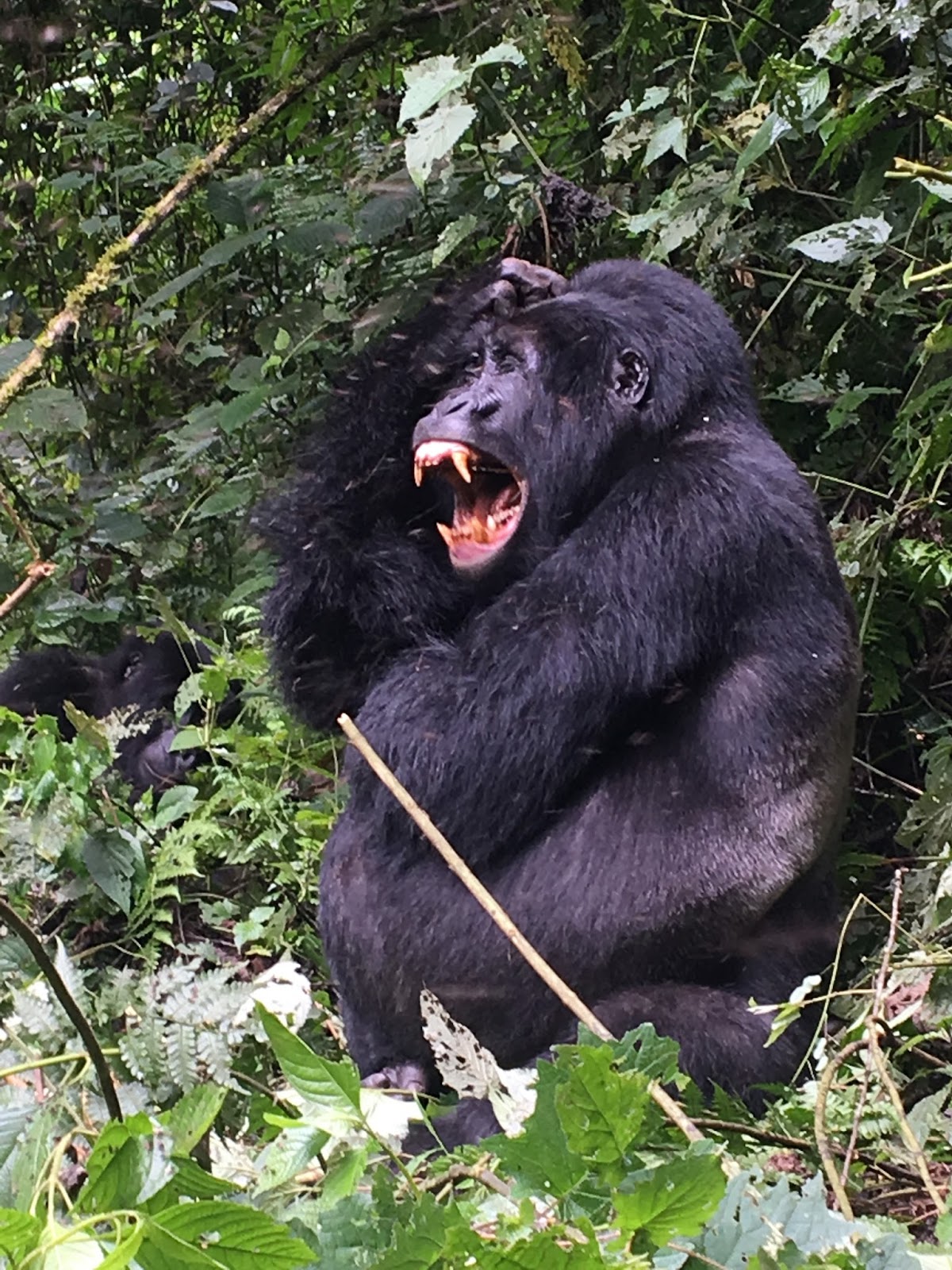
Whenever I mentioned that I was going to be an English Language Fellow in Mbarara, Uganda, almost always somebody said something to the effect of, "You're so lucky because you'll be right near  the gorillas!" And they were totally right. Working in Mbarara means that I'm only a few hours away from the opportunity to track gorillas and it's an experience that I started planning as soon as I arrived in the country.


There aren't many places in the world where one can encounter gorillas and there are only about 900 mountain gorillas in the wild, currently only found in Uganda, Rwanda and the Democratic Republic of the Congo. Many people choose to see gorillas in Uganda because of increased prices in Rwanda and problems with safety and stability in the DRC. Opting to do a gorilla trek in Uganda is still quite an investment, however, with high season permits costing around $600 and low seasons ones around $450. In contrast, doing a gorilla trek in Rwanda can typically cost over $1000.  When Sean and I arrived in early October, we joined a group of expats planning a gorilla trek in late November. This made the experience more affordable because November is the rainy, off season and going in a group decreases costs of hiring a car and a driver. A gorilla trek has to be planned a bit in advance because official permits have to be acquired and paid for in Kampala through the Ugandan Wildlife Association and more often than not the demand for permits outnumbers the supply.

Last Friday afternoon after teaching communication class, the group of us set out for Bwindi Impenetrable National Park, which was about a five hour drive passing through Kabale. The last two hours of the journey involved rough mountain roads and we ended up getting a flat tire. Fortunately, everyone in the group was positive and outgoing and we enjoyed a few beers on the veranda of a roadside hotel while waiting for a new tire to be delivered. We reached Rushaga Gorilla Camp at about 7:30 p.m. and had a lovely set dinner together at 8 p.m. Everyone headed to bed early in anticipation of the hike to the gorillas the following day.


Saturday began very early with breakfast at 6:15 a.m. and a hike to the gorilla tracking headquarters for the briefing which began at 8:00 a.m. We joined about twenty-five other excited hikers from all over the world for an hour-long session explaining the history of the program, the habitat and ecology of the gorillas and the rules for the trek. We were warned that because of the enormity of the park, some groups might hike up to 5 hours before seeing the gorillas whereas other groups might only have to hike for 30 minutes. There are several different gorilla families located in Bwindi and we were divided up into groups of no more than eight people to visit one of them. Before we had arrived, experienced Ugandan gorilla trackers had set out to locate each of the families so that they could radio their location to our guide to cut down on hiking time. Our trekking group consisted of 8 tourists, one guide, one porter and two soldiers in the front and back for protection against poachers and aggressive mountain elephants.


After the briefing, we met our guide, learned which family we would track, picked out walking sticks and introduced ourselves to the rest of our group. We started the hike at nine and after about 30 minutes of hiking our guide received a radio call notifying us that the gorilla family had changed direction so we had to turn around and start off again on a new trail. After only hiking for a short while, it was easy to see why the forest had been named "Impenetrable" as the trekking was difficult due to dense trees and growth. Since it was the rainy season, trails were slick and everybody was slipping and falling when there were steep ascents and descents. Other challenges during the hike were mobs of biting safari ants, thick clouds of mosquitoes, lots of thorny undergrowth and wet stream crossings. After two hours of hiking, we stopped and waiting for the gorilla trackers to recommend a specific route to find our family. Once we received the information, we started hiking off trail into the thick, untamed bush of Bwindi National Park. Two guides went in front with machetes to help clear the way and our group slowly descended into the thick rainforest for one final hour. I have never hiked in such a challenging environment before and it made all of us imagine what it must have been like for early explorers navigating new landscapes with no ready-made trails.


Rounding the corner and seeing the group of mountain gorillas for the first time was a magical and surreal experience. Since the gorillas in Bwindi are habituated, we were able to get and stay very close for the full hour-long experience. Being 'habituated' means that the gorillas had been exposed to humans often and thus were quite accustomed to us being a certain distance away. We watched them play with each other, snack, nap and talk to each other using loud grunts and coughs. Our group consisted of nine gorillas: one silverback male, three babies and five other younger males and females. For most of the hour, they stayed in one area but when they started walking to a different place we were able to follow them at a safe distance. It was fascinating to see them interact with each other as they were eerily humanlike.


The hour passed much too quickly and all too soon it was time to hike back to the park headquarters. Everyone had a fantastic experience and there were no doubts as to whether it was worth the time, effort and money to commit to seeing such amazing animals in the wild. We made it back to camp at about 3:00 p.m. and enjoyed cold beers, warm showers and lots of photo and video sharing. Doing a gorilla trek exceeded my expectations and is something that I would recommend to anyone who enjoys hiking and who is interested in seeing wildlife in their natural habitat. I can now understand why so many people said it was a "must-do" experience for me and Sean during my time in Uganda as an ELF.

Read More 2 comments | Posted by Sarah Sanderson edit post

2017 Marine Corps Ball

Posing with the marines and their birthday cake
One of the benefits of being an English Language Fellow is learning about how a U.S. Embassy functions as well as understanding more about the professional and social lives of the American diplomats who work there. In the social calendar of the embassy, the two most important events are the 4th of July celebration and the annual Marine Corps Ball, which is held every November. This year, Sean and I were invited to attend and we wouldn't wait to experience another fun and interesting tradition of working internationally with the State Department.


The Marine Corps Ball (MCB) celebrates the birthday of the Marine Corps - November 10, 1775. It's a very formal occasion which is usually well-attended by American and international diplomats and marines. This year, the U.S. Embassy, Kampala MCB was held at Speke Resort and Conference center, about 20 minutes outside the capital. Sean and I decided to make a weekend out of the event and reserved two nights at Speke which was a great opportunity to get out of Mbarara, enjoy Lake Victoria, play ultimate frisbee in Kampala and take advantage of the largest lap pool in East Africa.

Ambassador Malac entering with the marines


Each MCB follows a prescribed formal agenda which includes a lot of tradition. Before the actual ball, attendees gathered at an outdoor bar for drinks, appetizers and conversation. After that, we were invited into the large ballroom and found our tables. The ambience felt like a military-style wedding - everyone was dressed to the nines, the decorations were extravagant and there were about 300 guests in attendance.


Before dinner, there was an official ceremony which included the presentation of the marines and the colors, speeches by invited guests and the U.S. Ambassador to Uganda, and the national anthem. My favorite part of the agenda was the cutting of the marine's birthday cake, which was accomplished with an actual sword. The first pieces were given to the oldest and youngest marines in attendance as well as Ambassador Malac. After all formal ceremonies and traditions had finished, we were invited to the buffet, which was fantastic and had an impressive array of international and local dishes. For dessert, we had pieces of the birthday cake, which were delicious.

Our beautiful table

After dinner, the music was turned up and everybody started dancing - Ambassador Malac was the first one on the dance floor! We also had the chance to take pictures in front of the official flags. Sean and I were seated at the table which had several other fellows and their partners and we made a lot of new friends. It was also a lot of fun to drink and dance with diplomats who I had only previously seen in business attire in professional situations at the embassy.

The party lasted until midnight and we were very happy that we had only a short walk to our room instead of a long bus ride back to Mbarara. After experiencing our first Marine Corps Ball, it's easy to see why many expats consider it their favorite event of the year. I hope we get to go again sometime!

Read More 1 Comment | Posted by Sarah Sanderson edit post
Newer Posts Older Posts Home

Wanderlust

  • In Mandarin: 旅遊癮 (lǚyóu yǐn)
      According to my Mandarin teacher, the term 'wanderlust' can best be translated as 'a travel addiction or craving'. In the above translation, 'yǐn' has several meanings such as 'a strong impulse', 'a longing', or 'a desire'.
  • About Me

    My Photo
    Sarah Sanderson
    I am currently in Mandarin language training as a new diplomat in the U.S. Foreign Service. Sean and I depart for Wuhan, China in November 2019 for my first tour in consular affairs.
    View my complete profile

    Sarah and Sean

    Sarah and Sean
    Grateful for my very tolerant, supportive and easygoing husband who's always game for a new adventure

    On Language Learning

    On Language Learning

    Disclaimer


    This website is not an official U.S. Department of State website. The views and information presented are the officer's own and do not represent the Foreign Service or the U.S. Department of State.

    Blogs I follow

    • I Should Probably Be Doing Something Else
      2 days ago
    • Dani Francuz Rose
      4 days ago
    • Buckets of Joy
      4 years ago
    • thesolesearch
      7 years ago
    • About | Travel Unraveled: Brazil
      8 years ago
    • Ken's Blog
      8 years ago
    • 7500 miles
      8 years ago
    • Just the Three of Us
      9 years ago
    • La Vida Eterna
      10 years ago
    • Give and Take: Oh darling, let's be adventurers
      11 years ago
    • From Minnesota to Minas | They don't sound that different, do they?
      11 years ago
    • ONE + 2
      11 years ago
    • Mike and Anna's Blog
      11 years ago

    Wanderlust

    Wanderlust

    Blog Archive

    • ▼  2020 ( 4 )
      • ▼  April ( 4 )
        • Handwritten notes and postcards
        • Love in the time of Corona
        • Quaren-time
        • Oh hey, blog - I've missed you!
    • ►  2019 ( 1 )
      • ►  January ( 1 )
    • ►  2018 ( 6 )
      • ►  September ( 1 )
      • ►  June ( 1 )
      • ►  April ( 1 )
      • ►  March ( 2 )
      • ►  January ( 1 )
    • ►  2017 ( 29 )
      • ►  November ( 2 )
      • ►  October ( 9 )
      • ►  September ( 1 )
      • ►  June ( 4 )
      • ►  May ( 2 )
      • ►  April ( 6 )
      • ►  February ( 4 )
      • ►  January ( 1 )
    • ►  2016 ( 68 )
      • ►  December ( 1 )
      • ►  November ( 8 )
      • ►  October ( 13 )
      • ►  September ( 2 )
      • ►  August ( 5 )
      • ►  July ( 6 )
      • ►  June ( 2 )
      • ►  May ( 4 )
      • ►  April ( 8 )
      • ►  March ( 3 )
      • ►  February ( 2 )
      • ►  January ( 14 )
    • ►  2015 ( 75 )
      • ►  December ( 9 )
      • ►  November ( 4 )
      • ►  October ( 9 )
      • ►  September ( 5 )
      • ►  August ( 15 )
      • ►  July ( 7 )
      • ►  June ( 5 )
      • ►  May ( 8 )
      • ►  April ( 5 )
      • ►  March ( 3 )
      • ►  February ( 1 )
      • ►  January ( 4 )
    • ►  2014 ( 62 )
      • ►  December ( 3 )
      • ►  November ( 4 )
      • ►  October ( 3 )
      • ►  September ( 11 )
      • ►  August ( 6 )
      • ►  July ( 3 )
      • ►  June ( 6 )
      • ►  May ( 5 )
      • ►  April ( 6 )
      • ►  March ( 9 )
      • ►  February ( 6 )
    • ►  2013 ( 134 )
      • ►  December ( 6 )
      • ►  November ( 8 )
      • ►  October ( 14 )
      • ►  September ( 8 )
      • ►  August ( 14 )
      • ►  July ( 3 )
      • ►  June ( 8 )
      • ►  May ( 12 )
      • ►  April ( 12 )
      • ►  March ( 19 )
      • ►  February ( 17 )
      • ►  January ( 13 )
    • ►  2012 ( 158 )
      • ►  December ( 11 )
      • ►  November ( 14 )
      • ►  October ( 15 )
      • ►  September ( 12 )
      • ►  August ( 10 )
      • ►  July ( 15 )
      • ►  June ( 6 )
      • ►  May ( 12 )
      • ►  April ( 16 )
      • ►  March ( 19 )
      • ►  February ( 17 )
      • ►  January ( 11 )
    • ►  2011 ( 128 )
      • ►  December ( 5 )
      • ►  November ( 4 )
      • ►  October ( 5 )
      • ►  September ( 2 )
      • ►  August ( 7 )
      • ►  July ( 7 )
      • ►  June ( 12 )
      • ►  May ( 17 )
      • ►  April ( 16 )
      • ►  March ( 17 )
      • ►  February ( 16 )
      • ►  January ( 20 )
    • ►  2010 ( 175 )
      • ►  December ( 18 )
      • ►  November ( 18 )
      • ►  October ( 15 )
      • ►  September ( 17 )
      • ►  August ( 13 )
      • ►  July ( 12 )
      • ►  June ( 13 )
      • ►  May ( 14 )
      • ►  April ( 14 )
      • ►  March ( 13 )
      • ►  February ( 12 )
      • ►  January ( 16 )
    • ►  2009 ( 71 )
      • ►  December ( 20 )
      • ►  November ( 20 )
      • ►  October ( 18 )
      • ►  September ( 10 )
      • ►  July ( 1 )
      • ►  April ( 1 )
      • ►  February ( 1 )
    • ►  2006 ( 23 )
      • ►  June ( 4 )
      • ►  May ( 6 )
      • ►  April ( 6 )
      • ►  March ( 4 )
      • ►  February ( 3 )

    Followers

    Popular Posts

    • Matching Couples' T-shirts
      One of the first things that caught my attention upon arriving in China was the amount of couples wearing matching shirts - they were ever...
    • Room Service
      What does Sean do? Room service at the Hilton, that's what. Except that at the Hilton you can't call it Room Service but rather ...
    • Happy Dragon Boat Festival!
      Today (Monday) is a national holiday in China and as I write this, fireworks are going off and everyone is happy (including me) that we don...
    • Turn-down service
      Somewhere along the orientation process I missed the fact that for one day a week I have to work a double shift. This is because this hotel...
    • Khao San Road (winter break)
      Before heading to Cambodia the next day, Sean and I spent one last night exploring Khao San Road in Bangkok. While we had been staying in t...
    • Blepharoplasty
      Yesterday, when I was teaching at my part-time job, a girl walked in to my class wearing sunglasses even though it was 8:00 in the evening. ...
    • Flight of the Conchords
      If you read the title of this post and thought, "What's a Conchord?" you would not be alone - I had similar questions when I f...
    • Countryside of Cambodia (winter break)
      Our first full day in Siem Reap we decided to take it easy and explore some of the surrounding area before we tackled the main tourist draw,...
    • Angkor Wat (winter break)
      When I first told people that Sean and I were going to try and make it to Cambodia during winter break, many of them said that we absolutely...
    • Culture Class: East meets West
      I must admit, I am having a blast working with these culture classes. It is especially fun because David, the new teacher has taken over m...

    Total Pageviews


    View My Stats
  • Search


    • Home
    • Posts RSS
    • Comments RSS
    • Edit

    © Copyright Wanderlust . All rights reserved.
    Designed by FTL Wordpress Themes | Bloggerized by FalconHive.com
    brought to you by Smashing Magazine

    Back to Top